This project focuses on accelerating the Fast Graphlet Transform (FGIT) library using NVIDIA's CUDA parallel computing platform.
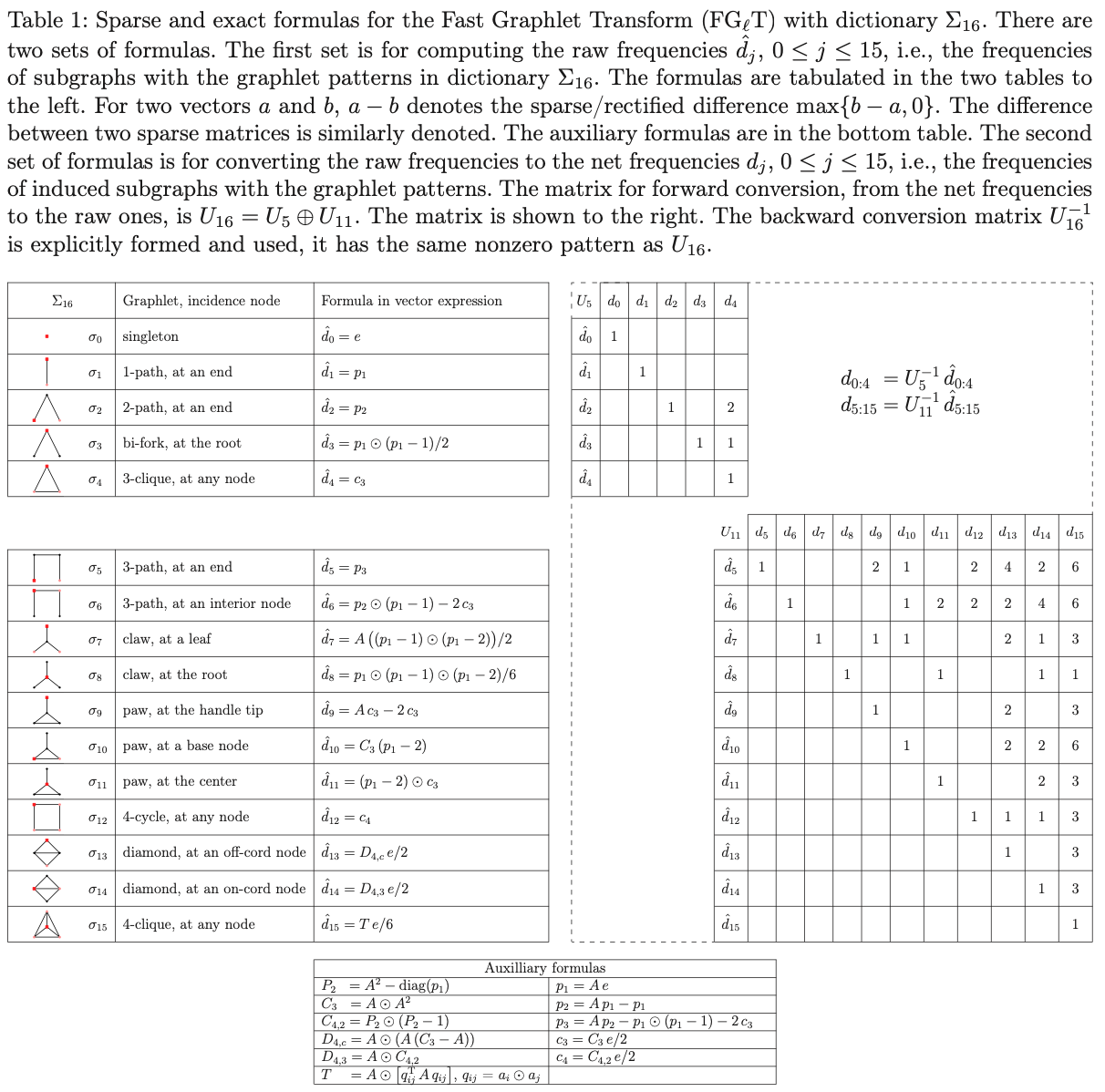
FGIT is a C/C++ multi-threading library designed for the Fast Graphlet Transform of large, sparse, undirected networks. It uses a dictionary of graphlets to capture topological connectivity quantitatively and transforms a graph
More details on this paper or via Github FGlT repository.
The primary objective of this project is to implement the calculation of specific graphlet frequencies (
- Input Format: Graphs are sourced from the SuiteSparse Matrix Collection in Matrix Market (
.mtx) COO format. - Format Conversion: The code converts COO data to CSR (Compressed Sparse Row) format via the
coo_to_csrfunction to allow for faster matrix access. - Undirected Graph Logic: To ensure the CSR format is correct for undirected graphs, the "COO edges" are read both forwards and backwards.
The project parallelizes the following calculations:
-
$\sigma_1$ : The vector of edge counts for each node, calculated by subtracting CSR pointers. -
$\sigma_2$ : Calculated using the$Ap1 - p1$ formula. To avoid matrix-vector multiplication, the code sums the "children" of a node and subtracts the count of the "parent" node. -
$\sigma_3$ : Calculated using the Hadamard product. -
$\sigma_4$ : The most complex frequency. To avoid full Matrix-Matrix multiplication ($A^2$ ), the code only calculates non-zero spots present in the original matrix$A$ and takes the half-sum of each row.
- Parallelization: Instead of sequential
forloops, the program spawns blocks of threads on the GPU. - Memory Management: Memory is split into Host (CPU) and Device (GPU) memory, with core formulas converted into
__global__functions.
The CUDA implementation demonstrates significant speedups, particularly for the parallelized portion of the code (
| Graph | Sequential Time (Total) | CUDA Time (Total) | Total Speedup | Parallelization Speedup |
|---|---|---|---|---|
| auto | 1.18s (1.73s) | 0.154s (0.65s) | 2.66x | 7.66x |
| great-britain-osm | 0.71s (2.10s) | 0.128s (1.54s) | 1.36x | 5.54x |
| delaunay_n22 | 2.12s (4.14s) | 0.12s (2.16s) | 1.91x | 17.6x |
| delaunay_n24 | 8.6s (16.67s) | 0.3s (8.5s) | 1.96x | 28.6x |
| coPapersDBLP | 14.10s (16.65s) | 0.9s (3.17s) | 5.25x | 15.67x |
| com-Orkut | >15min | 107s (129s) | >8x | ? |
Times formatted as: Calculation Time (Total Run Time).
The source code includes both Sequential and Parallel branches.
To compile and run the standard C implementation:
gcc src/serial.c -o bin/serial
./bin/serial [MatrixMarket.mtx]To compile and run the GPU-accelerated implementation:
nvcc src/parallel.cu -o bin/parallel
./bin/parallel [MatrixMarket.mtx]